
Commonly Confused English Words — The Pairs That Trip Up Everyone (Even Natives)

Language-learning writer · Published August 13, 2026
You know the shame. You hit send, and a half-second later your eyes land on it: “your welcome.” Too late. And somewhere, someone is judging you — unfairly, because this has nothing to do with how good your English is.
English is full of words that sound the same, look the same, or mean almost the same. Mixing them up isn’t a sign you’re bad at the language. It’s a sign the language is booby-trapped. Here are the traps, and the one-line trick that defuses each.
The sound-alikes: identical to your ear
These are the ones that wreck your writing, because when you say them there’s no difference at all. Don’t believe me? Listen — same sound, different spelling, different meaning:
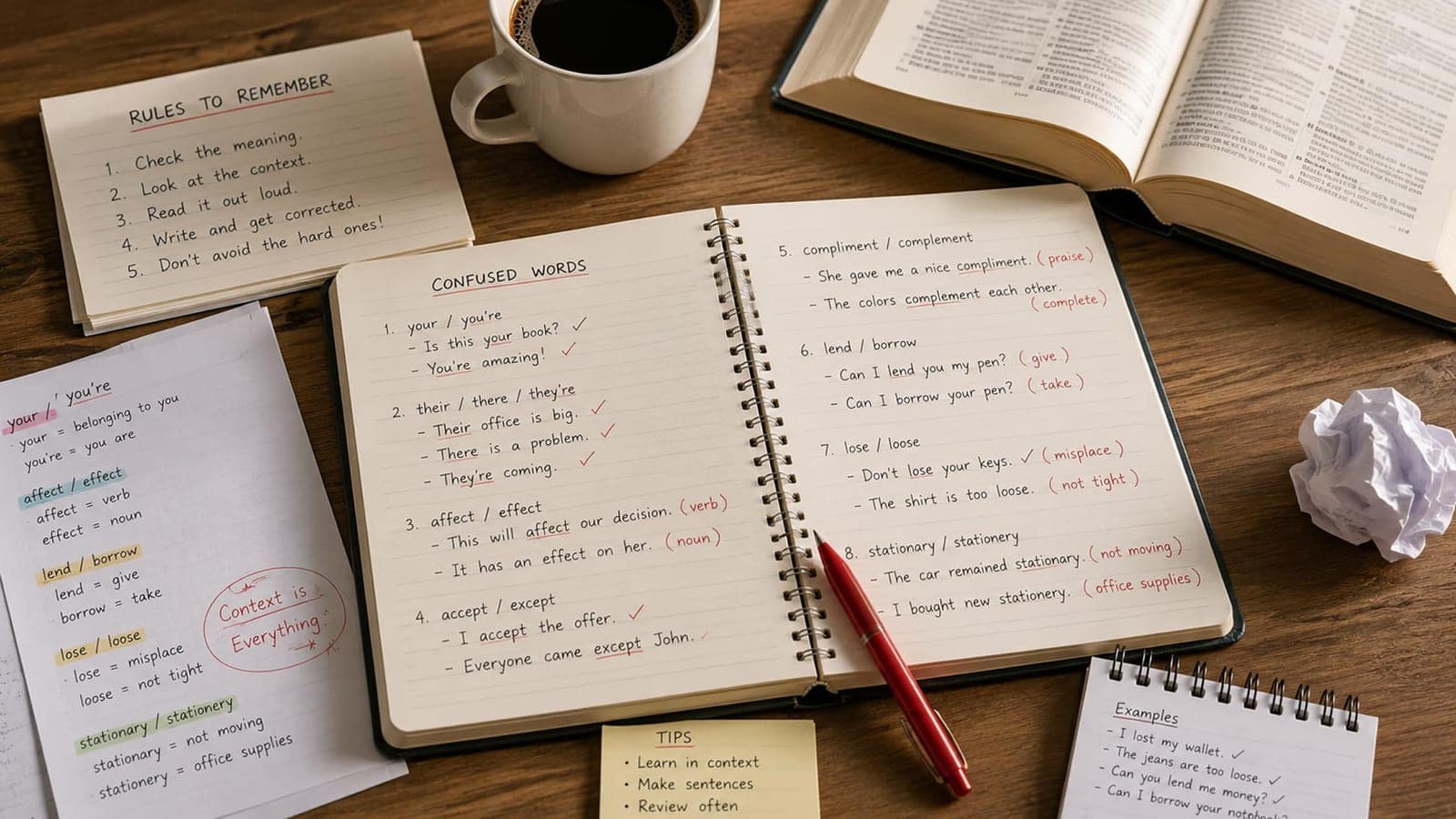
- their / there / they’re — their = belonging to them; there = a place; they’re = they are. Trick: they’re always unpacks into “they are.” If it doesn’t, it’s one of the other two.
- your / you’re — you’re = you are (that welcome mat: “you are welcome” → you’re welcome). If you can’t swap in “you are,” it’s your.
- to / too / two — two is the number; too means “also” or “excessively” (it has an extra “o,” like something extra); to is everything else.
- its / it’s — it’s = it is / it has, always. Its = belonging to it (like his, no apostrophe). “The city lost its charm” — not “it is charm,” so no apostrophe.
Hear how each pair is one sound? That’s the whole problem. Your ear can’t help you here — only the rule can. Which is oddly good news: it means there’s nothing to “get better at” except learning four small patterns.
The look-alikes: one letter, whole different word
These sound different but sit so close on the page that the wrong one slips out:
- lose / loose — lose (one o) = you can’t find it, or you didn’t win. loose (two o’s) = not tight. You lose a loose tooth. Mnemonic: loose is so loose it’s got room for an extra o.
- then / than — then = time (“we ate, then left”). than = comparison (“bigger than”). If you’re comparing, it’s than.
- quiet / quite — quiet = no noise. quite = fairly/very. A quiet room can be quite nice; swapping them makes a mess.
- desert / dessert — the sweet one has two s’s, because you always want a second helping. The dry sandy one has one.
The meaning-traps: genuinely close, genuinely tricky
Here the words aren’t twins — they actually mean similar things, which is why even careful writers slip:
- affect / effect — affect is usually the verb (to affect = to influence), effect is usually the noun (an effect = a result). Rain affects your mood; the rain has an effect on your mood. A for action, E for end result.
- fewer / less — fewer for things you can count (fewer emails), less for things you can’t (less time). One wrinkle: amounts of time, money and distance take less even though you can count them — “less than five miles,” “less than ten dollars.” That “10 items or less” sign? It breaks the textbook rule — items are countable, so it “should” be fewer.
- who’s / whose — who’s = who is / who has. whose = belonging to whom. “Who’s coming?” (who is) vs “Whose coat is this?” (belonging to whom).
- i.e. / e.g. — e.g. = “for example” (example given); i.e. = “in other words” (that is). Not interchangeable, though almost everyone treats them as if they were.
Why even natives get these wrong
Here’s the thing that should make you feel better: your/you’re and their/there/they’re are among the most common writing mistakes native English speakers make. Not because they don’t know — because they’re on autopilot, and the ear offers no warning when two words sound identical.
Learners who actually studied the rule often beat natives on exactly these words. So drop the shame. This isn’t an intelligence test. It’s a set of small patterns nobody sat you down and explained — until now.
How to make them stick
Rules fade; seeing them in the wild doesn’t. The reason these finally click for people isn’t a list like this one — it’s meeting the words correctly used, again and again, in real English until the right one just looks right.
And you’ll meet them a lot: their, there, your and its are some of the highest-frequency words in English, so across the 1,405 books and 130-plus podcasts in our library they show up on nearly every page and in nearly every episode. That’s the fix — not this list, but seeing the right one used correctly, over and over.
So when you’re reading or listening to real content and you spot one of these pairs used well, notice it. Save it. That’s the loop that turns a rule you memorized into a word you feel — and it’s exactly the tap-and-save flow we built into Hinto, though a notebook works too.
A couple of these traps are really pronunciation in disguise — if lose/loose or then/than still blur together when you say them, our English pronunciation guide drills the minimal pairs that pull them apart. And if you like this kind of word-level detail, English idioms is the fun next step: phrases where the words are all easy but the meaning hides anyway.
Learn the four sound-alikes cold, keep this page for the rest, and you’ll never send “your welcome” again.
Frequently asked questions
What are the most commonly confused words in English? +
The classics are the sound-alikes — their/there/they're, your/you're, to/too/two, its/it's — plus a set of look-alikes and meaning-traps like affect/effect, fewer/less, lose/loose, then/than, and who's/whose. The sound-alikes cause writing mistakes because the words are pronounced identically; the meaning-traps cause errors because the words are genuinely close in sense.
Why is it 'its' without an apostrophe for possession? +
Because 'its' follows the pattern of other possessives like 'his' and 'hers,' which have no apostrophe. The apostrophe version, 'it's,' is only ever short for 'it is' or 'it has.' The quick test: if you can replace it with 'it is,' use 'it's'; if you can't, use 'its.' 'The dog wagged its tail' — you can't say 'it is tail,' so no apostrophe.
Do native English speakers confuse these words too? +
Constantly. Your/you're and their/there/they're are among the most common mistakes native speakers make in writing, precisely because the words sound identical — the ear gives no clue, so only the learned spelling rule helps. If anything, learners who studied the rules often get them right more reliably than natives working on autopilot. It's not about intelligence; it's about noticing the pattern.
When do I use 'fewer' vs 'less'? +
Use 'fewer' for things you can count and 'less' for things you can't. Fewer emails, fewer people, fewer bottles — all countable. Less water, less noise — not counted individually. One exception: amounts of time, money and distance take 'less' ('less than five miles'). The supermarket sign that says '10 items or less' is the classic textbook violation; items are countable, so the rule says 'fewer.'
Related articles
- Learning English with AI — What It's Genuinely Good At, and Where It Quietly Fails You AI can be a tireless English tutor — or a confident liar that teaches you wrong. Here's what AI chatbots are genuinely good at for learning English, where they fail, and how to use them without being misled.
- English Short Stories for Learners — The Fastest Way to Finish a Real Book in English Short stories are the shortcut to reading real English: you finish one in a sitting, so you actually finish. Graded picks from A2 to C1, including the best C1 short stories to read now.
- English Phrasal Verbs and Idioms — Why Lists Don't Work, and What Does Phrasal verbs and idioms are what make English sound native — and memorizing lists of them barely works. Here's why, plus the method that actually gets them to stick: learning them in real context.
- English Idioms That Actually Come Up — 30 Real Ones, and How to Learn Them The idioms you'll actually hear in real English — grouped by theme, each with a plain meaning and where it shows up. Plus the honest way to learn idioms without sounding like a textbook.