
How to Learn English by Yourself — A Self-Study System That Actually Sticks

Language-learning writer · Published July 27, 2026
Teaching yourself English has one failure mode, and it isn’t laziness. It’s drift. You watch a video here, do a lesson there, save a word you never see again, and six months later you’re roughly where you started — busy but not better. The people who succeed alone aren’t more disciplined. They just run a system instead of drifting, and the system is simple enough to stick to.
Here’s the whole thing.
The five inputs
A complete self-study week touches five things. Not all every day — but all across the week, or you develop lopsided English (the classic: understands everything, can’t speak).
- Listening — a podcast or video at your level, most days. This is the biggest lever; give it the most time.
- Reading — a few pages of a book you follow about 80% of. Reading is where vocabulary and grammar quietly compound.
- Speaking — even alone. Talk out loud, shadow a podcast, describe your day. Arrange real conversation when you can.
- Vocabulary — save the words you keep meeting and review them. This is the difference between input that sticks and input that evaporates.
- Grammar — light and reactive. A reference you open when something confuses you, not a daily drill.
Miss one occasionally, fine. Skip one for months and it becomes your weakness.
Replace what a teacher actually did
A class gives you three things you now have to supply yourself — and naming them is how you stop drifting:
- Curriculum — the “what next.” A teacher sequenced it; alone, you need one decision you don’t re-litigate every week. Pick your level’s content and a single order to move through it, then stop shopping.
- Accountability — someone who noticed if you skipped. Replace it with a visible streak or a standing slot — the twenty minutes on your commute, the fifteen before bed — so the day carries you instead of your willpower.
- Feedback — the one thing hardest to fake alone. You can self-supply input and vocabulary, but nobody corrects your output unless you arrange it. Book a cheap tutor or a language exchange even once a week: it’s the input most self-taught learners quietly skip, and the reason they stall at “understands everything, speaks poorly.”
Wire those three into a normal week — input daily, review in the gaps, speaking booked once or twice — and self-study stops being a fuzzier version of a class and becomes its own, faster thing.
The tools you actually need
Fewer than you’d guess — a shelf of half-used apps teaches less than one you finish. Four cover it:
- Real content at your level — podcasts, video, books. The core of everything. See the best podcasts, YouTube channels, and books.
- A way to save and review words — a notebook, Anki, or an app that does it as you read.
- A grammar reference — Murphy’s English Grammar in Use for the gaps.
- A speaking outlet — a tutoring or language-exchange app, or just your own voice.
That’s it. Everything else is optional.
A clear, level-friendly show is an easy first “listening” input to build the habit on:
The mistakes that eat months
Self-study fails in predictable ways, and each one is a teacher-function you didn’t replace:
- No curriculum, so you collect apps. Five tools half-explored feel productive and teach almost nothing. One finished path beats all of them.
- No accountability, so the habit lapses. Miss a few days, then a week, then it’s “I’ll restart Monday” forever. A streak or a fixed slot is boring, and it works.
- No feedback, so you never speak. It’s the uncomfortable part, so it’s the one people skip — which is exactly why they get stuck understanding everything and saying little. Arrange correction early.
- Over-hard content, mistaken for ambition. A native podcast at B1 feels like immersion; mostly it’s just discouragement in disguise. Stay where you follow ~70–80%.
Where a tool fits
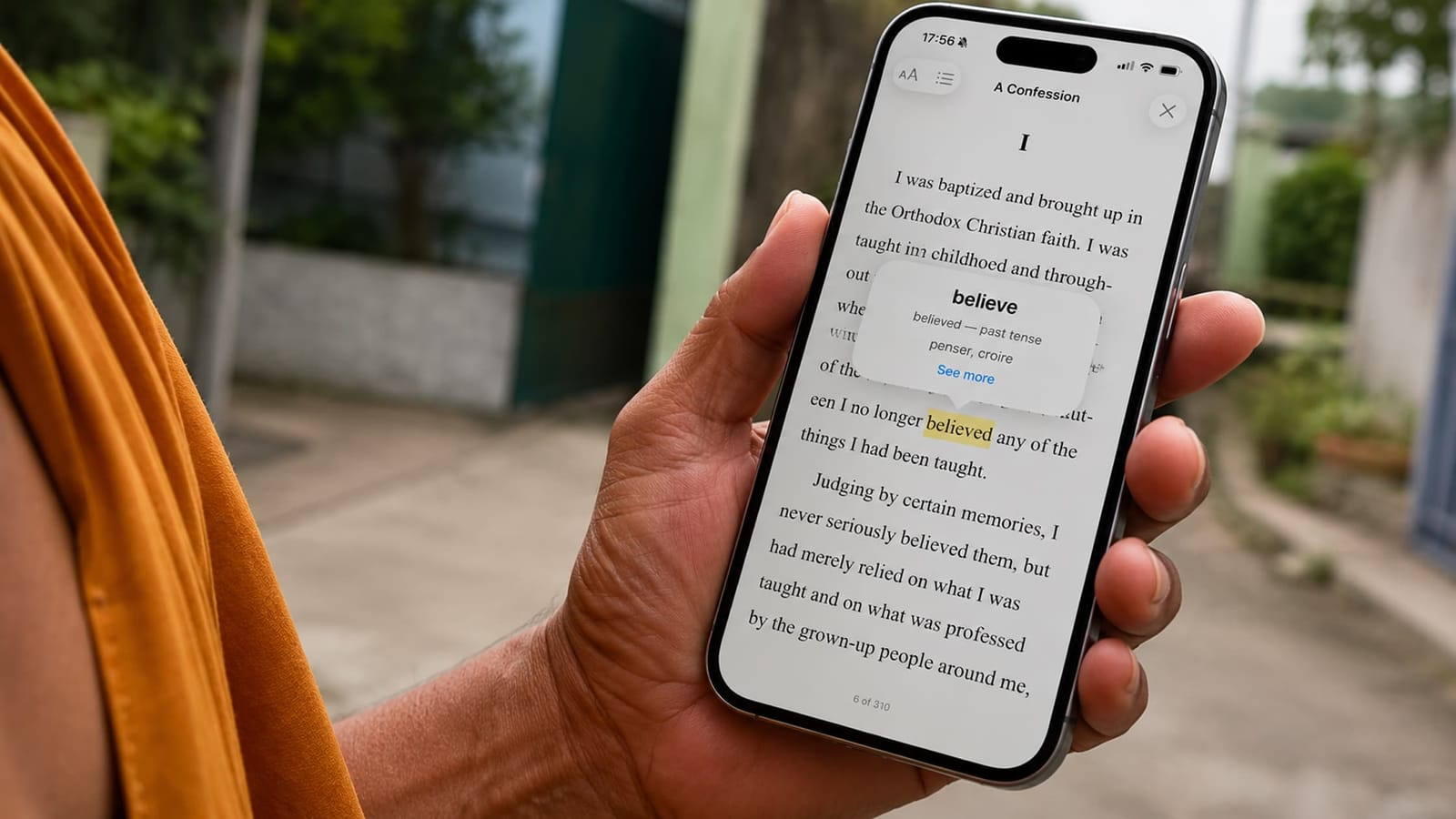
You can run this whole system on free content, a notebook, and your own voice — truly. What a good app buys you is one thing: less friction. Fewer taps between “no idea what that word means” and “saved, and it’ll come back later” — which is the difference between keeping the habit and dropping it on a busy Thursday.
That’s the narrow job we built Hinto for — real content, tap any word for its meaning, and saved words resurface for review on their own (free to start, on iPhone and Android). The system matters more than the app, though. The full method is in how to learn English, and the stage-by-stage version is in the guides for beginners, intermediate and advanced.
Teaching yourself English isn’t about willpower or talent. It’s about running a small, boring, effective system every day until fluency sneaks up on you. Pick the five inputs. Do them this week. Then do them again.
Frequently asked questions
Can you learn English by yourself without a teacher? +
Yes. A teacher helps with speaking feedback and accountability, but everything else — listening, reading, vocabulary, grammar — you can do alone with real content at your level. Most fluent self-taught learners got there through daily input (podcasts, books, video), saving and reviewing words, and speaking practice they arranged themselves. The key is a consistent system, not a classroom.
What's the best self-study routine for English? +
Touch five inputs across the week: listening (a podcast at your level), reading (a few pages of a book you follow ~80% of), speaking (a tutor, partner, or talking out loud), vocabulary (saving and reviewing words you meet), and light grammar (a reference for gaps). Around five hours a week, done daily rather than in one block, is enough to make steady progress.
How can I practice speaking English alone? +
Talk out loud to yourself about your day, describe what you're doing, or shadow a podcast — replay a sentence and repeat it, copying the rhythm. Record yourself and listen back. For real conversation, arrange low-cost sessions on tutoring or language-exchange apps. Speaking alone builds fluency and confidence; feedback from a human refines accuracy.
What are the most common self-study mistakes? +
Collecting apps instead of finishing one; consuming content that's too hard (which feels like immersion but is just noise); never speaking because it's uncomfortable; and chasing new methods every few weeks instead of staying consistent. The learners who succeed alone pick a simple system and repeat it daily for months.
Related articles
- The Best YouTube Channels to Learn English — Real Channels, Sorted by How Hard They Are The best English on YouTube isn't 'learn English' channels — it's the educational ones made to be understood. A level-by-level guide with real channels and how to watch them at your level.
- Can You Learn English While Sleeping? The Honest Answer — and What Actually Works Playing English audio while you sleep won't teach you the language — learning needs attention. But active listening will. Here's the truth about passive listening and the techniques that actually build your ear.
- The Best Books to Learn English — What 1,405 Graded Titles Taught Us About Reading at Your Level We tagged all 1,405 books in Hinto's library by CEFR level. The numbers explain why beginners struggle to find readable English books — and which titles actually work at A2, B1, B2 and C1.
- How Long Does It Take to Learn English? The Honest, Hour-by-Hour Answer The honest answer isn't months or years — it's hours. Here's a realistic CEFR timeline from A1 to C1, what speeds it up, and why 'fluent in 3 months' is marketing.